
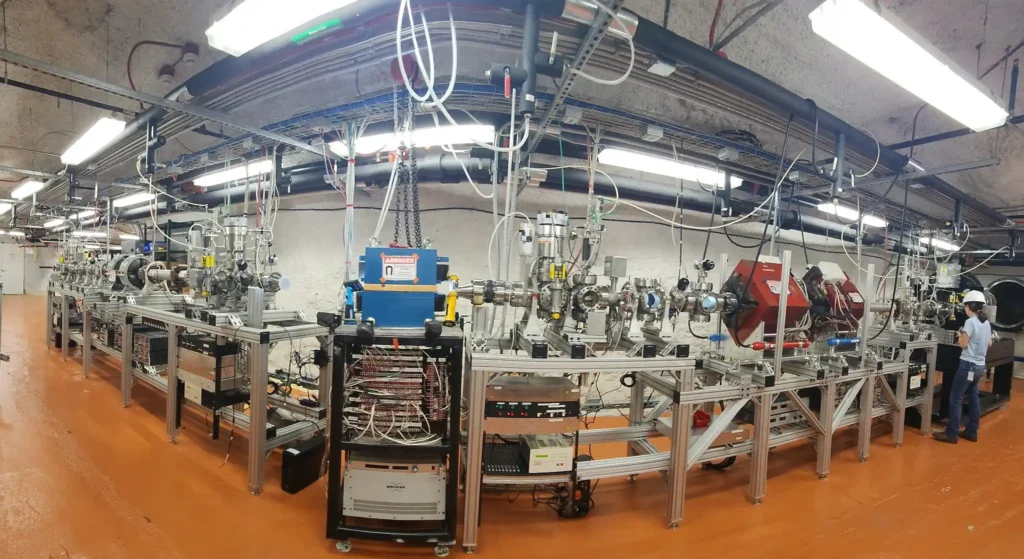
Nearly a mile beneath Earth’s surface—far from sunlight, satellites, and the noise of the modern world—scientists are recreating the reactions that once powered the birth of the universe. At a depth of 4,850 feet inside the Sanford Underground Research Facility (SURF), the Compact Accelerator System for Performing Astrophysical Research (CASPAR) experiment operates in near silence, shielded by layers of ancient rock. Here, physicists do not look outward with telescopes—they look inward, reproducing stellar fusion reactions atom by atom to confront one of humanity’s oldest questions: how did the universe forge the elements that make life possible?
The universe began in an extreme state where nuclear reactions helped determine what kinds of matter could exist at all. In the first minutes after the Big Bang, only the lightest elements—hydrogen, helium, and traces of lithium—were formed; nearly everything heavier came later, forged inside stars through fusion. Yet the details of these early and stellar reaction pathways remain among the central challenges of modern physics. CASPAR was launched to measure key fusion reactions directly, reproducing in the laboratory the processes that shaped the universe’s chemical evolution.
CASPAR is a National Science Foundation (NSF)–funded underground accelerator laboratory housed at SURF in the Black Hills of South Dakota. Installed on the 4,850-foot level beneath the town of Lead, CASPAR occupies space once carved out by the Homestake Mine—formerly the largest and deepest gold mine in North America before its closure in 2002. More than 370 miles of shafts, drifts, and ramps were excavated during the mining era; today, roughly 12 miles are maintained for scientific research, supported by the U.S. Department of Energy.
This site holds a unique place in the history of modern physics. In the mid-1960s, the Homestake Mine hosted the pioneering solar neutrino experiment led by Ray Davis and John Bahcall—work that reshaped our understanding of the Sun and particle physics. That effort culminated in the 2002 Nobel Prize in Physics, awarded to Davis and shared with Masatoshi Koshiba and Riccardo Giacconi. Today, that legacy continues underground, where CASPAR extends the tradition of discovery—no longer searching for gold, but for the faint nuclear reactions that illuminate how the universe was forged.
CASPAR was among the first laboratory-based experiments to come online at SURF after the facility opened. Commissioned around 2015, it reached an early milestone with the successful delivery of its first ion beam in 2017—marking the true beginning of underground accelerator operations. From 2018 to 2021, during its primary science run, CASPAR carried out key low-energy nuclear astrophysics measurements, including reactions such as ⁷Li(α,γ)¹¹B, ²²Ne(α,γ)²⁶Mg, ¹⁸O(α,γ)²²Ne, and ²⁷Al(p,γ)²⁸Si, providing critical data for stellar burning models and the universe’s chemical evolution.
In 2021, operations were paused as excavation activities intensified nearby for the Deep Underground Neutrino Experiment, which required extensive underground blasting. To protect sensitive equipment, CASPAR entered a planned hibernation phase lasting until 2024. After nearly three years of underground silence, the revival began in May 2024, when undergraduate and graduate students—working alongside principal investigators—returned to condition the lab space and prepare it for renewed operations and equipment delivery.
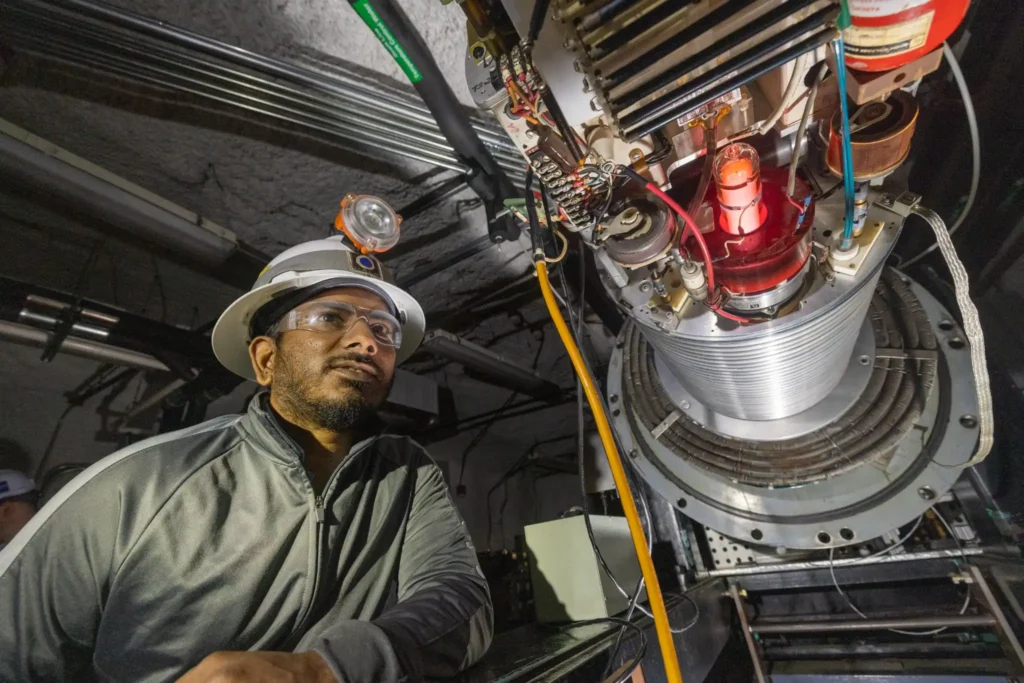
The restart marked a turning point. In July 2025, CASPAR achieved its first plasma milestone—an essential step in reconditioning the accelerator and restoring full functionality. By November 2025, the experiment successfully delivered its first beam, reopening a new chapter of discovery. With that beam, CASPAR did more than restart an experiment—it reopened a window onto the hidden story of creation. Each successful run brings scientists closer to understanding how the universe transformed simple hydrogen and helium into everything we know today: the oxygen we breathe, the calcium in our bones, and the gold in a wedding ring. The mystery of our origins may remain elusive, but step by step, beam by beam, CASPAR continues to reveal how the universe built us—and why we are driven to understand it.
As the James Webb Space Telescope uncovers the light of the universe’s first stars, CASPAR works underground to explain the nuclear processes that shaped that light. Deep beneath South Dakota at SURF, CASPAR recreates low-energy fusion reactions responsible for producing—and destroying—lithium in early stellar environments, directly addressing one of cosmology’s most persistent puzzles: the mismatch between predicted and observed lithium abundances. By measuring rare reactions that help bypass the mass-5 and mass-8 bottlenecks, CASPAR provides crucial nuclear inputs for interpreting Webb’s elemental signatures and tracing how the universe evolved from primordial hydrogen and helium toward richer chemistry.

Among the most important experiments returning to CASPAR’s underground program is the measurement of the ⁷Li(α,γ)¹¹B fusion reaction at previously inaccessible astrophysical energies. This single reaction sits at a rare crossroads between nuclear astrophysics and applied fusion science. In the cosmos, it helps constrain how lithium is depleted in stars and how nucleosynthesis pathways move beyond bottlenecks created by the absence of stable mass-5 and mass-8 nuclei—key pieces of the Big Bang lithium problem. On Earth, the same reaction draws interest in aneutronic fusion concepts, which aim to minimize neutron production and could enable cleaner energy conversion with reduced radioactive waste. By probing this elusive process deep underground, CASPAR links the earliest chemistry of the universe to technologies still on the horizon—showing how the smallest reactions can illuminate both where we come from and where we might go next.
Share this article
Md Nurul Haque is a researcher, entrepreneur, and social-impact advocate. He is the founder of "Break Or Die LLC", a global platform uniting ethical business, independent journalism, and humanitarian action. With a background in experimental nuclear physics and a deep commitment to social justice, his writing explores inequality, power structures, science, and human dignity. He believes storytelling is a tool not just to inform—but to change lives.
Incredible work. Good luck to the invisible scientists whose dedication drives discovery.