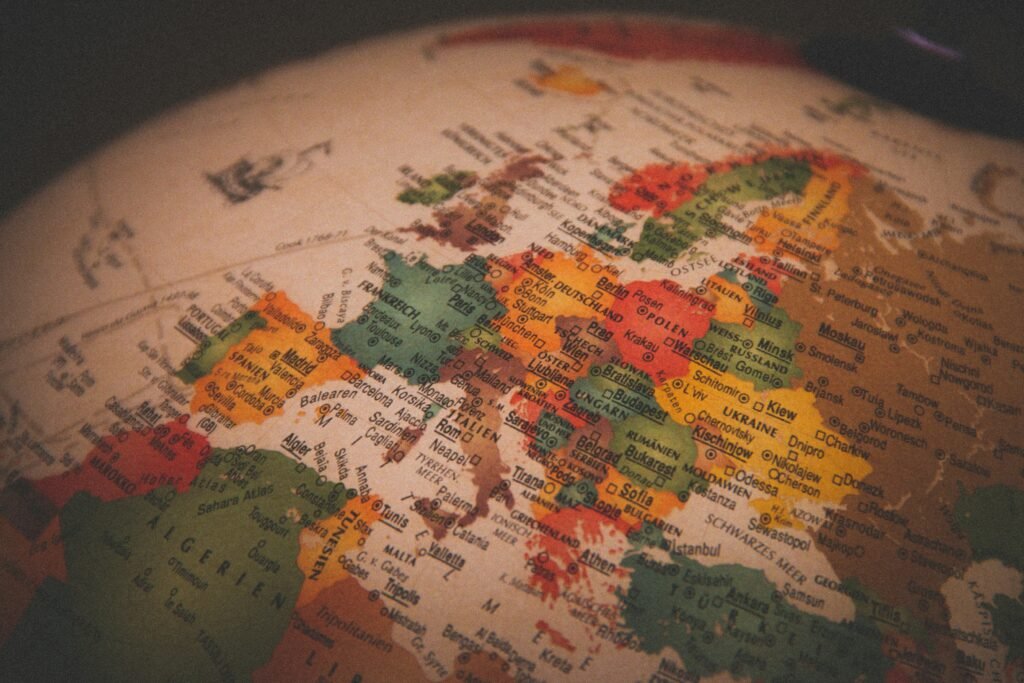

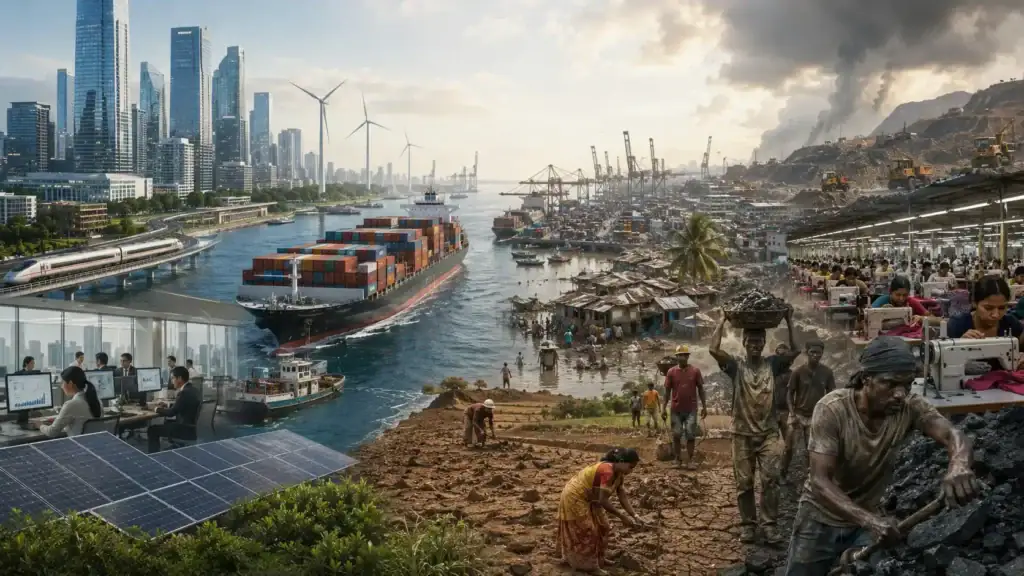
The world is often described as one shared planet, connected by trade, technology, finance, climate, and migration. Yet this same world remains deeply divided by wealth, power, history, and opportunity. One of the most common ways scholars, economists, and political commentators describe this divide is through the terms Global North and Global South.
The Global North generally refers to countries that are wealthier, more industrialized, and more powerful in global politics and finance. These countries are mostly located in the northern hemisphere, including much of Europe and North America. The Global South, on the other hand, generally refers to countries across Africa, Latin America, Asia, the Caribbean, and parts of the Pacific that have historically experienced colonialism, resource extraction, economic dependency, and limited influence in global decision-making.
The terms are not strictly geographical. Australia and New Zealand, for example, are located in the southern hemisphere but are usually considered part of the Global North because of their higher income levels, advanced economies, and political alignment with wealthy industrialized countries. The Global South is therefore not simply a location on a map. It is a political and economic condition shaped by history.
The Global North-South Divide
The term “Global South” gained wider attention in the late 1960s, when American writer Carl Oglesby used it in the context of the Vietnam War to describe countries that were being politically and economically dominated by richer powers. Over time, the term became more widely used among scholars, activists, and policymakers to discuss global inequality beyond the older language of “developed” and “underdeveloped” countries.
One of the most influential attempts to visualize this divide came through the Brandt Report, formally titled North-South: A Programme for Survival. Published in 1980 by an independent commission led by former West German Chancellor Willy Brandt, the report highlighted the widening gap between wealthy industrialized countries and poorer nations. It popularized a world map divided by what later became known as the Brandt Line. Countries above the line were generally wealthier and more industrialized, while countries below the line were more likely to face poverty, weaker institutions, and lower levels of development.
The Brandt Line was never perfect. No single line can fully explain the complexity of global inequality. Still, it helped people visualize a painful truth: the world economy had been built in a way that concentrated wealth and decision-making power in some regions while leaving others dependent, vulnerable, and underrepresented.
Colonialism and the Roots of Unequal Growth
The inequality between the Global North and the Global South did not happen by accident. It has deep roots in history, especially in colonialism.
Beginning in the 15th century, European powers such as Spain and Portugal expanded their trade and military presence beyond Europe. They were later followed by Britain, France, the Netherlands, Germany, and others. What began as exploration and trade soon became a race for land, labor, resources, and political control.
Across Africa, Asia, the Americas, and the Caribbean, colonial powers took control of territories, extracted raw materials, forced local populations into labor, and reorganized economies to serve European interests. Africa suffered some of the most brutal consequences, including the transatlantic slave trade, artificial borders, resource plunder, and long-term political disruption. Indigenous communities in the Americas and Australia also faced violence, displacement, and cultural destruction.
The primary motivation behind colonialism was not charity or development. It was extraction. Colonies supplied raw materials, labor, land, and markets. Colonial powers built wealth by taking from the territories they controlled while limiting the ability of colonized societies to develop their own industries and institutions.
India is one of the most frequently cited examples. Before British colonial dominance, the Indian subcontinent was a major center of global trade, manufacturing, textiles, and agriculture. Under colonial rule, its economy was reorganized to serve British interests. Local industries weakened, resources were extracted, and wealth flowed outward. Similar patterns appeared across much of the Global South.
The consequences of colonialism were not temporary. Colonial systems disrupted local economies, damaged social structures, and created political boundaries that often ignored cultural, ethnic, and historical realities. Even after independence, many countries inherited fragile institutions, export-dependent economies, and financial systems designed during colonial rule.
This is how the Global South began paying for the growth of the world: through land, labor, minerals, crops, taxes, forced production, and stolen opportunity.
How Modern Supply Chains Continue the Pattern
Formal colonial rule ended in most countries during the 20th century, but many of its economic patterns continue in new forms. Today, the global economy often appears modern and borderless, but its structure still favors the Global North.
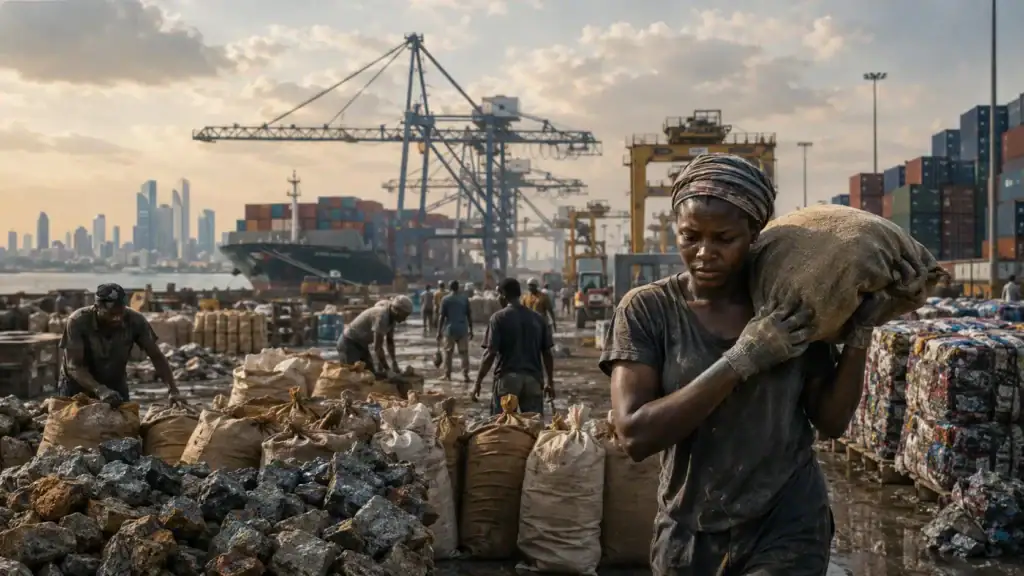
A common pattern is simple: raw materials and cheap labor come from the Global South, while the highest profits, branding, technology, finance, and value addition are concentrated in the Global North.
The global clothing industry is one example. Countries such as Bangladesh and Vietnam produce garments for major international brands. Workers in these countries often receive low wages, while the final products are sold globally at far higher prices. The largest share of profit usually goes not to the workers or producing countries, but to brand owners, retailers, investors, and marketing systems based in wealthier economies.
A similar pattern can be seen in minerals. Many of the minerals needed for the global clean-energy transition—such as cobalt, lithium, nickel, copper, and rare earth elements—are found in countries across the Global South. According to Oxfam International, Global South countries hold roughly 70 percent of transition mineral reserves, while much of the investment and profit remains concentrated in the Global North and China. In many cases, the countries that hold the resources receive environmental damage, labor exploitation, and political instability, while richer economies receive the finished technologies and financial returns.
This does not mean Global South countries have no agency or responsibility. Corruption, weak governance, conflict, and poor planning inside these countries also contribute to underdevelopment. But it would be unfair to ignore the larger structure. The global supply chain is not neutral. It was built through centuries of unequal power, and it still rewards those who control capital, finance, technology, and markets more than those who provide labor and resources.
Climate Change and Unequal Responsibility
The injustice does not end with trade. It also appears clearly in climate change.
The Global North’s industrial rise was powered by coal, oil, gas, mining, manufacturing, and mass consumption. For more than two centuries, wealthy countries emitted huge amounts of greenhouse gases while building their cities, industries, transport systems, and military power. Today, the consequences of those emissions are being felt across the planet.
Yet the countries least responsible for historical emissions are often among the most vulnerable to climate impacts. The IPCC Sixth Assessment Report notes that least developed countries and small island developing states have much lower per-capita emissions than the global average. Still, they face some of the harshest consequences: floods, droughts, cyclones, rising sea levels, food insecurity, water scarcity, and climate-driven displacement.
For countries like Bangladesh, climate change is not a future theory. It is already visible in coastal erosion, salinity intrusion, extreme flooding, and displacement. Across Africa, droughts and changing rainfall patterns threaten agriculture and food security. In small island states, rising seas are not just an environmental issue; they are an existential threat.
The unfairness is clear. The countries that contributed the least to the crisis are being forced to pay some of the highest costs of adaptation. According to the UNEP Adaptation Gap Report 2025, developing countries may need hundreds of billions of dollars per year for climate adaptation by 2035, while international public adaptation finance remains far below what is needed.
This is why climate change is not only an environmental crisis. It is also a justice crisis. The same world system that allowed some nations to grow through high emissions now asks poorer nations to survive the consequences with limited resources.
Debt Dependency and the Cost of Borrowing
Another major burden on the Global South is debt.
Many developing countries borrow from international institutions, wealthy governments, private lenders, and major creditor countries to fund infrastructure, stabilize budgets, respond to crises, or repay older loans. Borrowing itself is not always bad. Roads, hospitals, schools, energy systems, and ports require investment. But when borrowing becomes a cycle of dependency, it can weaken national sovereignty and limit development.
Recent data shows how serious the problem has become. According to UN Trade and Development, developing countries’ external debt reached $11.4 trillion in 2023, equivalent to 99 percent of their export earnings. In the same year, they paid hundreds of billions of dollars in net interest to creditors. The World Bank has also reported that developing countries paid out $741 billion more in principal and interest than they received in new financing between 2022 and 2024, the largest net debt outflow in half a century.
The problem is not only the size of the debt. It is also the structure. Poorer countries often borrow at higher interest rates than richer countries, even when they need money for basic development. When global interest rates rise, their debt payments become even more expensive. When their currencies weaken, loans denominated in dollars become harder to repay. When export earnings fall, debt pressure grows.
In many cases, countries borrow new money to repay old loans. This creates a cycle that is extremely difficult to escape. A large portion of national budgets goes toward debt servicing instead of public investment. Schools remain underfunded. Hospitals remain weak. Infrastructure projects are delayed. Social programs are cut. The dream of self-reliance becomes harder to achieve.
Loans from institutions such as the International Monetary Fund and the World Bank can come with conditions. Some reforms may be necessary, but others can force governments to reduce public spending, cut subsidies, privatize services, or adopt policies that are politically and socially painful. Meanwhile, loans from private creditors or major bilateral lenders can also create long-term financial pressure.
Debt has therefore become one of the modern tools through which inequality is reproduced. Colonialism may have formally ended, but many Global South countries remain trapped in financial systems they did not design and cannot easily control.
What Must Change
The first step toward solving these problems is acknowledging that global inequality is structural. It is not simply the result of poor choices by individual countries. It is the result of history, power, trade rules, debt systems, climate injustice, and unequal control over technology and finance.
But acknowledgment is not enough. The Global South also needs stronger internal cooperation, better governance, and more strategic leadership.
Africa provides an important example. The African Union is the continent’s largest political platform, bringing together 55 member states. Regional organizations such as the Economic Community of West African States, the Common Market for Eastern and Southern Africa, and the Arab Maghreb Union also play important roles in regional cooperation. These institutions have faced limitations, but they remain essential for building stronger collective power.
For Africa and the wider Global South, internal priorities must include education, healthcare, infrastructure, energy access, food security, anti-corruption reforms, and conflict resolution. Without stronger governance and regional cooperation, it will be difficult to negotiate fairer terms with global powers, corporations, and financial institutions.
At the same time, the Global North must accept responsibility for the systems from which it has benefited. This means supporting fairer trade rules, responsible investment, debt relief, climate finance, technology transfer, and stronger protections for workers and communities in supply chains.
Global corporations must also be held accountable. Profit cannot continue to depend on cheap labor, weak environmental rules, and resource extraction from vulnerable countries. If the Global South provides the labor, land, minerals, and markets that support global growth, then it deserves a fairer share of the value created.
A More Just Future
Despite being home to most of the world’s population and a large share of its natural resources, the Global South has remained underrepresented in the global financial and political order. Its people have labored in mines, farms, factories, ports, and plantations. Its lands have supplied the minerals, crops, fuels, and raw materials that helped build modern prosperity. Yet its communities continue to face poverty, debt, climate vulnerability, and limited influence in global decision-making.
Colonialism ended in legal terms, but many of the systems created by colonial power remain alive in trade, finance, debt, and climate politics. This is why independence alone did not transform the fate of many Global South nations. Political freedom did not automatically bring economic justice.
Still, the future does not have to repeat the past. A more just world is possible if nations, institutions, and citizens recognize that development cannot be built on permanent inequality. The Global South does not need sympathy; it needs fairness, representation, investment, and the freedom to shape its own future.
The world’s growth has never been free. Someone has always paid the price. For too long, that price has been paid by the Global South. A fairer global order begins by admitting that truth—and then changing the systems that keep it alive.
Share this article

Md. Azizul Islam
Md. Azizul Islam holds both an MBA and a BBA from the Institute of Business Administration, Jahangirnagar University. With a strong passion for learning and writing, he explores contemporary social, political, and global issues through an analytical and thoughtful lens.